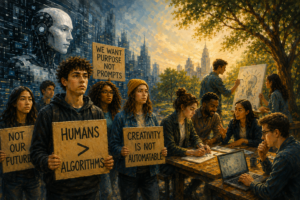

For women leading teams in Los Angeles and beyond, the conversation around leadership is evolving. While technical expertise and industry knowledge remain important, organizations are increasingly seeking leaders who can navigate complexity, inspire people, build trust, and lead through uncertainty. In midsize and large organizations alike, leadership has become less about authority and more about influence, communication, emotional intelligence, and purpose.
As artificial intelligence continues to transform industries, many professionals are asking an important question: What skills will remain essential in the future of work? The answer is clear. While technology can automate processes and analyze data, it cannot replace the uniquely human capabilities that define exceptional leadership.
The Growing Demand for Human-Centered Leadership
Organizations today face unprecedented challenges. Rapid technological change, shifting workforce expectations, hybrid work environments, and increasing demands for transparency require leaders who can effectively engage people while driving results.
Research consistently shows that employees are more engaged, productive, and committed when they work under leaders who demonstrate empathy, integrity, strong communication skills, and emotional intelligence. These qualities are especially valuable in large organizations where leaders must navigate diverse teams, competing priorities, and organizational change.
For women leaders, these strengths often become powerful differentiators. The ability to build relationships, foster collaboration, and create inclusive environments is increasingly recognized as a strategic advantage rather than simply a leadership style.
Why Emotional Intelligence Matters More Than Ever
Among the most sought-after leadership skills today is emotional intelligence. Leaders who understand themselves, manage their emotions effectively, and communicate with empathy are better equipped to handle conflict, motivate teams, and build trust across organizations.
Emotional intelligence includes self-awareness, self-regulation, motivation, empathy, and social skills. These competencies help leaders navigate difficult conversations, inspire confidence during times of change, and create workplace cultures where employees can thrive.
In an age where many technical tasks are becoming automated, emotional intelligence remains one of the most valuable leadership assets a professional can possess.
Moving Beyond Management to Leadership
Many professionals reach a point in their careers where technical expertise alone is no longer enough to advance. The transition from individual contributor to organizational leader requires a different set of skills.
Successful leaders must understand organizational behavior, communication, change management, decision-making, ethics, and strategy. They must be able to see the broader picture while maintaining a deep commitment to the people they lead.
This is why more professionals are pursuing graduate education focused specifically on leadership development. A master’s degree in organizational leadership provides the framework, knowledge, and practical skills needed to lead effectively in complex organizations.
Leadership in the Age of Artificial Intelligence
Artificial intelligence is reshaping industries, creating new opportunities and challenges for organizations of every size. While AI can improve efficiency and support decision-making, it cannot replace human judgment, ethical reasoning, creativity, or purpose.
The future belongs to leaders who can combine technological awareness with human-centered leadership capabilities. Organizations need individuals who can guide teams through change, make thoughtful decisions, communicate vision, and foster cultures of trust and innovation.
Leadership is becoming one of the most future-resilient professional skill sets available.
Developing the Next Generation of Leaders
At the California Institute of Advanced Management (CIAM), leadership education is grounded in Peter Drucker’s philosophy of Management as a Liberal Art—a human-centered approach that recognizes organizations exist to serve people and society.
CIAM’s Master of Arts in Organizational Leadership (MAOL) is designed for working professionals who aspire to lead with purpose, integrity, and impact. Through a flexible one-year format that is 90% online, students develop advanced leadership capabilities in communication, organizational behavior, strategic thinking, emotional intelligence, ethics, and change management.
The program prepares graduates to lead confidently in today’s evolving workplace while developing the human skills that technology cannot replace.
The Future Needs Exceptional Leaders
The question is no longer whether organizations need strong leaders. The question is whether enough professionals are prepared to meet the challenge.
For women seeking to advance their careers, increase their influence, and make a meaningful impact within their organizations, investing in leadership development may be one of the most important decisions they make.
As industries continue to evolve, leadership remains fundamentally about people. And the organizations that thrive in the future will be led by individuals who understand how to bring out the best in others while navigating change with confidence, integrity, and purpose.
Learn more about CIAM’s Master of Arts in Organizational Leadership and discover how you can develop the leadership skills organizations need most in the age of AI.