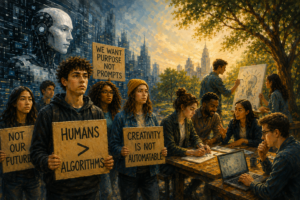

Artificial intelligence is rapidly changing how we work. It can analyze data, draft reports, generate ideas, summarize complex information, write code, and produce recommendations in seconds. As these capabilities continue to expand, an important question emerges: If technology can increasingly provide the answers, what becomes the responsibility of the human being?
Peter Drucker’s thinking offers a compelling way to consider this question.
Long before artificial intelligence became part of everyday professional life, Drucker recognized that knowledge was becoming one of society’s most important resources. He wrote extensively about the rise of the knowledge worker—the professional whose primary contribution comes not from physical labor, but from knowledge, judgment, expertise, and the ability to apply what they know effectively.
Drucker also understood that technology would continually transform the nature of work. Yet his philosophy was never centered on technology itself. It was centered on people, purpose, responsibility, contribution, and results.
That distinction may be more important today than ever.
Technology Is a Tool. Purpose Is Human.
AI can help us accomplish tasks faster, but efficiency alone does not tell us whether we are accomplishing the right tasks.
An organization can automate a process, analyze thousands of data points, or generate an impressive strategy in seconds. But technology cannot independently determine why an organization exists, whom it should serve, what those people truly value, or what responsibilities its leaders have to society.
Those are questions of purpose and judgment.
This is where Drucker’s famous Five Most Important Questions remain strikingly relevant:
- What is our mission?
- Who is our customer?
- What does the customer value?
- What are our results?
- What is our plan?
Notice that these are not primarily technical questions. They are human questions. They require reflection, conversation, interpretation, and sometimes the courage to challenge assumptions that have guided an organization for years.
AI may help us explore possible answers. But humans still have to decide which questions deserve to be asked.
The Knowledge Worker in the Age of AI
Drucker described knowledge-worker productivity as one of the great management challenges of the 21st century. Today, AI adds an entirely new dimension to that challenge.
If machines can perform more knowledge-based tasks, the value of the professional may increasingly shift away from simply possessing information toward knowing how to interpret it, question it, contextualize it, and use it responsibly.
Knowing something is not the same as understanding it.
Generating an answer is not the same as exercising judgment.
And having more information does not necessarily lead to better decisions.
The future knowledge worker therefore may need something Drucker emphasized throughout his work: the ability to manage oneself, continually learn, understand one’s contribution, and remain focused on effectiveness rather than activity.
Asking Better Questions
Perhaps one of the greatest risks of AI is not that technology will think for us, but that we will become comfortable allowing it to do so.
When answers become effortless, questioning becomes even more important.
Instead of simply asking, What can AI do?, leaders might ask:
What should we do? What problem are we actually trying to solve? Who benefits from this decision? What assumptions are we making? What might the data be missing? What are the consequences? And what does a meaningful result actually look like?
These are fundamentally questions of leadership.
Drucker’s work reminds us that management is ultimately a human responsibility. Technology changes. Tools evolve. Entire industries are transformed. But organizations still need purpose. People still need judgment. Leaders still have responsibilities. And decisions still have consequences.
The defining capability of the AI era, therefore, may not be knowing how to generate more answers.
It may be knowing how to ask better questions.
Because when answers are everywhere, the quality of our questions may become one of our most distinctly human advantages.
From Data to Judgment
This philosophy is also reflected in CIAM’s Master of Science in Data Analytics (MSDA) program. Data and AI can reveal patterns, identify opportunities, and generate powerful insights—but meaningful leadership requires knowing what to ask of the data and what to do with the answers.
Through a curriculum grounded in Management as a Liberal Art, CIAM prepares students to approach analytics not simply as a technical discipline, but as a tool for thoughtful decision-making. The future will need professionals who can do more than analyze data—it will need people who can interpret it, question it, and use it responsibly to make better decisions.