
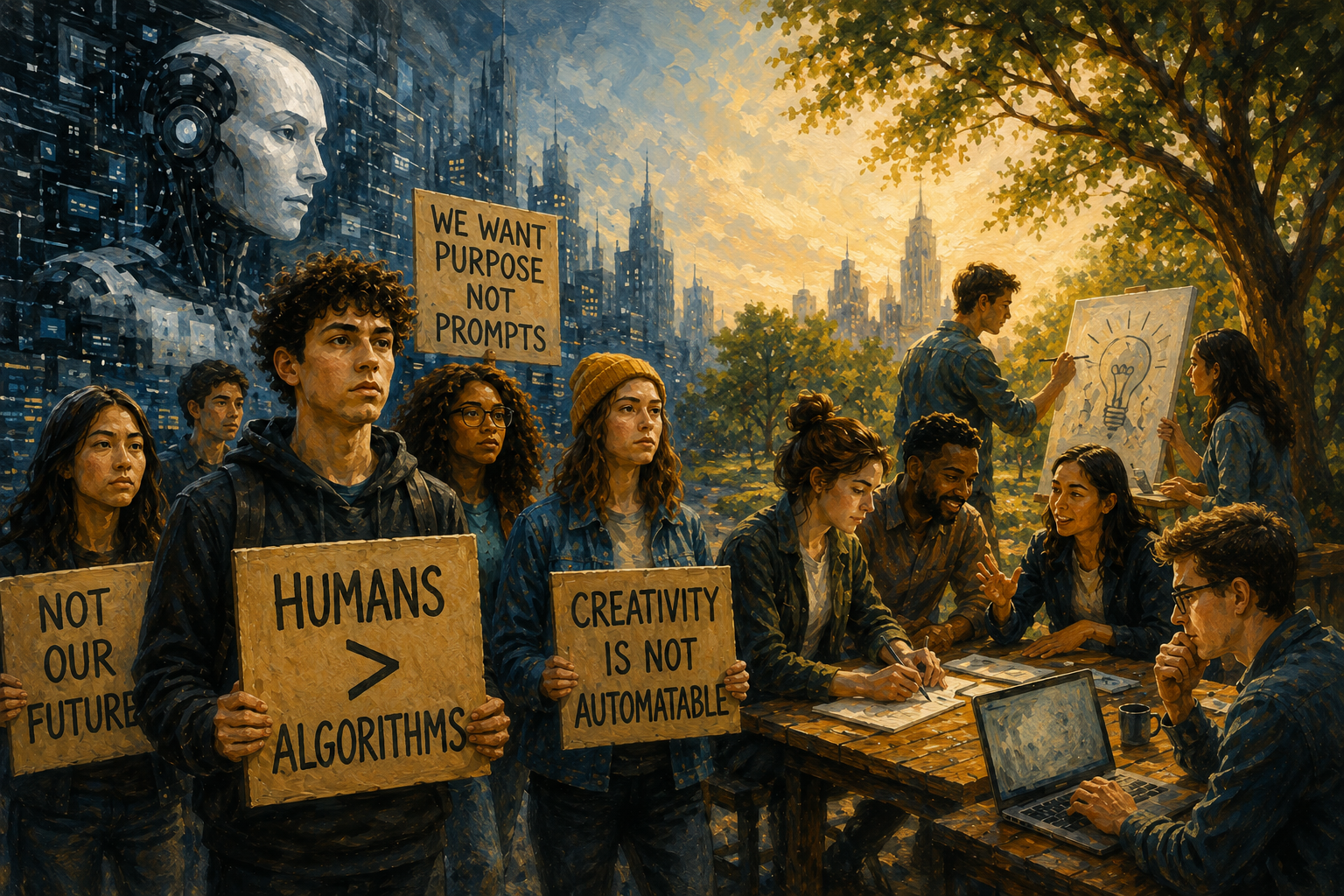
Artificial intelligence (AI) is transforming nearly every industry—from education and healthcare to finance, marketing, and technology. Businesses are adopting AI at record speed, universities are debating its role in the classroom, and employers increasingly expect graduates to understand AI tools before entering the workforce.
Yet amid this rapid innovation, an unexpected trend has emerged.
Generation Z and Millennials—two generations often described as “digital natives”—are becoming some of the strongest voices calling for responsible AI adoption. Their concerns are not rooted in fear of technology itself, but in a deeper question:
What happens when technology begins replacing the uniquely human skills that define leadership?
As organizations race to automate processes and increase efficiency, younger professionals are asking whether society is sacrificing creativity, authenticity, ethics, and meaningful human connection along the way.
Their message offers an important lesson for today’s leaders.
Gen Z Isn’t Rejecting AI—They’re Questioning How It’s Being Used
Recent headlines have captured a growing tension surrounding artificial intelligence.
At several college commencement ceremonies this year, graduates openly expressed frustration during speeches focused on AI and automation. Rather than celebrating technological advancement, many questioned what AI means for their future careers, creative work, and long-term opportunities.
These reactions reflect a broader cultural conversation occurring across universities, workplaces, and social media.
Generation Z has spent its entire life surrounded by technology. Smartphones, social media, streaming platforms, and digital collaboration are second nature.
Artificial intelligence, however, feels different.
Unlike previous technologies that expanded human capability, many young professionals worry AI may begin replacing human contribution altogether.
The concern isn’t whether AI should exist.
The concern is whether organizations are allowing technology to replace judgment instead of supporting it.
Why Millennials and Gen Z Are Concerned About Artificial Intelligence
Several factors are driving skepticism among younger generations.
1. Job Security
Entry-level positions have traditionally served as the foundation for career development.
Today, many of those responsibilities—including writing reports, summarizing meetings, conducting research, and creating presentations—can be completed using generative AI.
This has raised legitimate questions about how young professionals will gain experience if many foundational tasks become automated.
2. Creativity and Original Thinking
Artists, writers, designers, musicians, and marketers continue debating AI-generated content.
While AI dramatically increases efficiency, many creators worry it also encourages sameness.
Original ideas, storytelling, and innovation have historically come from human experience—not algorithms trained on existing content.
3. Authenticity
Perhaps the most significant concern is authenticity.
Across social media, younger audiences have become increasingly skilled at identifying overly polished or AI-generated content.
Consumers now value transparency, genuine perspectives, and real human experiences more than ever before.
Ironically, the more artificial content becomes available, the more valuable authentic human communication becomes.
The AI Revolution Is Creating a Leadership Revolution
Throughout history, every technological breakthrough has changed the workplace.
Artificial intelligence is no exception.
However, technology doesn’t eliminate leadership.
Instead, it changes which leadership skills become most valuable.
As AI handles repetitive and analytical tasks, organizations are placing greater importance on skills that cannot easily be automated.
These include:
- Emotional intelligence
- Ethical decision-making
- Critical thinking
- Communication
- Relationship building
- Organizational culture
- Conflict resolution
- Trust
- Adaptability
- Change leadership
These abilities have always mattered.
Today, they have become strategic competitive advantages.
The Future of Work Requires Human-Centered Leadership
The World Economic Forum continues to identify analytical thinking, resilience, leadership, creativity, and emotional intelligence among the fastest-growing workplace skills.
These competencies represent something AI cannot fully replicate.
Artificial intelligence can process enormous amounts of information.
It cannot inspire people.
It cannot build trust during organizational change.
It cannot coach employees through uncertainty.
It cannot create meaningful workplace culture.
Leadership has always been about people.
That reality has not changed.
If anything, AI has made it even more important.
Why Human Skills Are Becoming More Valuable Than Technical Skills
For years, organizations emphasized technical expertise.
Today, technical knowledge evolves rapidly.
Software changes.
Platforms change.
Artificial intelligence changes.
Human leadership principles remain remarkably consistent.
Employees continue looking for leaders who communicate clearly.
Customers continue trusting organizations that operate with integrity.
Teams continue performing best when leaders create purpose, psychological safety, and accountability.
Technology may reshape how work gets done.
Leadership determines whether people want to do that work together.
What Employers Are Looking for in the AI Era
Today’s employers increasingly seek professionals who combine technological literacy with exceptional interpersonal skills.
The most valuable leaders understand how to use AI without becoming dependent on it.
They ask better questions.
They think critically.
They recognize ethical implications.
They communicate across diverse teams.
Most importantly, they understand that technology should strengthen human potential—not replace it.
This balance will define successful organizations throughout the coming decade.
Leadership Education Must Evolve Alongside Artificial Intelligence
As AI continues reshaping industries, leadership education must evolve as well.
Tomorrow’s leaders need more than technical proficiency.
They must understand organizational behavior, communication, ethics, change management, strategic thinking, and people-centered leadership.
Organizations increasingly need professionals capable of leading through complexity while preserving the human values that technology cannot replicate.
Preparing leaders for this future requires an educational philosophy that places people—not technology—at the center of management.
Preparing Leaders for a Human-Centered Future
At the California Institute of Advanced Management (CIAM), leadership has always been about more than management.
Grounded in Peter F. Drucker’s philosophy of Management as a Liberal Art, CIAM’s Master of Arts in Organizational Leadership (MAOL) prepares professionals to lead with purpose, integrity, and responsibility in an increasingly technology-driven world.
Rather than competing with artificial intelligence, effective leaders learn how to work alongside it while strengthening the uniquely human capabilities organizations need most.
Students develop expertise in:
- Organizational leadership
- Ethical decision-making
- Change management
- Communication
- Organizational culture
- Employee engagement
- Strategic leadership
- Innovation
- Human-centered management
As artificial intelligence transforms the workplace, these capabilities become increasingly valuable—not less.
The future of leadership will not be defined by who uses AI the most.
It will be defined by who leads people the best.
In an age increasingly shaped by algorithms, authentic leadership remains humanity’s greatest competitive advantage.