
Leadership has changed dramatically over the past century. The qualities once associated with effective leadership—authority, hierarchy, and command-and-control management—are no longer enough to guide organizations through today’s rapidly evolving business landscape. In an era shaped by artificial intelligence, globalization, digital transformation, and shifting workforce expectations, organizations are seeking leaders who can do far more than manage operations. They are looking for leaders who can inspire people, navigate complexity, communicate with empathy, and lead with purpose.
As industries continue evolving, so too does the definition of leadership itself. This shift is one of the reasons why graduate education in organizational leadership has become increasingly valuable for professionals looking to advance their careers and make meaningful impact.
FROM INDUSTRIAL-ERA MANAGEMENT TO HUMAN-CENTERED LEADERSHIP
In the early 20th century, leadership was largely centered around efficiency, structure, and productivity. During the industrial era, organizations prioritized standardized processes, top-down decision-making, and rigid workplace hierarchies. Leaders were expected to maintain control, maximize output, and ensure operational efficiency.
As businesses expanded globally and workplaces became more collaborative, leadership began shifting toward relationship-building and team development. By the late 20th century, organizations increasingly recognized that employee engagement, communication, emotional intelligence, and organizational culture directly influenced performance and innovation.
Today, leadership has evolved into something far more multidimensional.
Modern leaders are expected to:
• Lead diverse teams across generations and cultures
• Navigate organizational change and uncertainty
• Integrate technology responsibly
• Foster innovation and collaboration
• Build ethical and sustainable organizations
• Communicate vision with clarity and empathy
• Balance business performance with social responsibility
In many ways, leadership today is no longer simply about authority—it is about influence, adaptability, and human connection.
THE LEADERSHIP SKILLS COMPANIES VALUE TODAY
Organizations are increasingly searching for professionals who possess both strategic business knowledge and strong interpersonal leadership capabilities. Technical expertise alone is no longer sufficient for long-term career advancement.
Some of the most in-demand leadership skills in today’s workforce include:
Emotional Intelligence
Leaders who understand how to manage relationships, communicate effectively, and navigate interpersonal dynamics are often better equipped to build high-performing teams and healthy workplace cultures.
Strategic Thinking
Organizations value leaders who can analyze complex situations, anticipate challenges, and make informed decisions that align with long-term organizational goals.
Change Management
As industries continue adapting to new technologies and economic shifts, leaders must know how to guide teams through uncertainty and organizational transformation.
Ethical Leadership
Consumers, employees, and stakeholders increasingly expect organizations to operate with integrity, transparency, and social responsibility. Ethical leadership has become a competitive advantage.
Communication and Influence
Modern leadership requires the ability to motivate teams, communicate vision clearly, and inspire collaboration across departments and industries.
Adaptability and Innovation
Leaders today must remain agile and open to continuous learning as technology and workplace expectations continue evolving.
WHY A MASTER’S DEGREE IN LEADERSHIP MATTERS
As organizations place greater emphasis on people-centered leadership, many professionals are turning to graduate education to strengthen their leadership capabilities and prepare for advancement opportunities.
A Master’s degree in Organizational Leadership helps professionals develop:
• Advanced leadership and management strategies
• Communication and team-building skills
• Organizational development expertise
• Conflict resolution and decision-making abilities
• Ethical and values-driven leadership practices
• Strategic thinking and change management frameworks
Graduate leadership education also provides students with opportunities to apply concepts to real-world organizational challenges, helping bridge the gap between theory and practice.
For many professionals, pursuing a leadership degree is not simply about career growth—it is about becoming a more effective leader capable of creating meaningful impact within organizations and communities.
THE FUTURE OF LEADERSHIP IS HUMAN-CENTERED
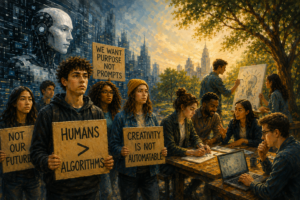
As artificial intelligence and automation continue reshaping industries, human-centered leadership is becoming more important than ever. Technology can streamline processes and analyze data, but it cannot replace empathy, ethical judgment, creativity, or the ability to inspire people.
Organizations increasingly recognize that sustainable success depends not only on innovation and profitability, but also on leadership that prioritizes people, purpose, and long-term impact.
DEVELOP PURPOSE-DRIVEN LEADERSHIP AT CIAM
At the California Institute of Advanced Management, the Master of Arts in Organizational Leadership (MAOL) program is grounded in Peter F. Drucker’s Management as a Liberal Art philosophy, which emphasizes ethical, human-centered leadership and meaningful organizational impact.
Designed for aspiring and emerging leaders, CIAM’s MAOL program helps students strengthen strategic leadership, communication, organizational development, and decision-making skills through practical, real-world learning. Students are empowered to lead with integrity while developing the tools needed to navigate today’s evolving global business landscape.
Whether you are looking to advance your career, strengthen your leadership capabilities, or create meaningful change within your organization, graduate education in organizational leadership can help prepare you for the future of leadership.