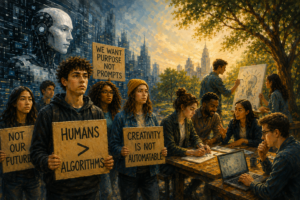

The Shift from Traditional Success to Purpose-Driven Careers
For decades, career success followed a predictable formula—higher salary, better title, more seniority. Today, that model is rapidly evolving. Gen Z is redefining success through purpose-driven careers, meaningful work, and leadership development that aligns with their values. For this generation, work is no longer just about income—it’s about impact, identity, and purpose. Organizations that fail to recognize this shift are already experiencing the consequences in disengagement, turnover, and increasing difficulty attracting top talent. What was once considered a cultural trend is now a fundamental shift in how work is defined.
Why Gen Z Is Redefining Career Success
Gen Z entered the workforce during a period of global disruption—economic uncertainty, a pandemic, climate concerns, and widespread social change. Rather than becoming disengaged, they have become more intentional. They are asking questions earlier than any generation before them: does this work matter, does this organization reflect my values, and will I feel proud of what I do here? As a result, career success is no longer defined solely by compensation or status, but by purpose, alignment, and meaning. Recent workforce data from 2025–2026 reinforces this shift, showing that 89% of Gen Z workers say purpose is essential to their job satisfaction, with nearly half willing to reject employers whose values do not align with their own. Financial stability still matters, but it is no longer enough on its own. A purpose-driven career has become a baseline expectation.
What a Purpose-Driven Career Looks Like Today
What a purpose-driven career looks like, however, is often misunderstood. It does not require working for a nonprofit or dedicating one’s life to solving global challenges. Instead, it is defined by connection and contribution—by the ability to see how one’s work fits into a larger mission. Gen Z is looking for alignment between their personal values and an organization’s purpose, evidence that the organization contributes beyond profit, and work that feels meaningful rather than interchangeable. What they will not tolerate is inconsistency. When leadership decisions contradict stated values, trust erodes quickly, and they are willing to walk away.
The Growing Demand for Leadership Development Programs
This shift is directly influencing how Gen Z approaches education and career development. Increasingly, they are seeking out leadership development opportunities and graduate programs that prepare them to lead with purpose, not just manage tasks. The demand for organizational leadership programs is growing because they offer something traditional education often does not: a focus on ethical decision-making, human-centered leadership, and real-world impact. For Gen Z, leadership is not just about authority—it is about responsibility.
The Rise of Purpose-Driven Female Leadership
One of the most important drivers of this transformation is the rise of purpose-driven female leadership. Gen Z women, in particular, are redefining what leadership looks like by prioritizing meaning, impact, and authenticity over traditional markers of success. They are not simply entering leadership roles—they are reshaping them. This has increased demand for leadership development programs that emphasize emotional intelligence, ethical reasoning, and values-based decision-making. As this shift continues, organizations must rethink how they develop and support leaders who reflect these expectations.
Human Dignity as the Foundation of Meaningful Work
At the core of purpose-driven work is a principle that is often overlooked in traditional business models: human dignity. Gen Z expects to be treated as individuals rather than as interchangeable roles within an organization. This requires more than surface-level initiatives. It demands genuine inclusion, transparency from leadership, and accountability when mistakes are made. Research consistently shows that employees who feel respected and valued are more engaged, more productive, and more likely to stay. Meaningful work cannot exist without dignity, and leaders play a central role in creating environments where both can thrive.
Why Organizations Must Adapt Now
Organizations that ignore this shift are already facing significant challenges. High turnover, low engagement, and difficulty recruiting are no longer isolated issues—they are symptoms of a deeper misalignment between what organizations offer and what the workforce expects. The business case for purpose-driven leadership is clear. When employees believe their work contributes to something meaningful, performance improves, innovation increases, and organizational culture strengthens. This is not a temporary generational preference; it is a long-term transformation in the nature of work.
The Leadership Skills Required for the Future of Work
Meeting this moment requires a different kind of leadership. Leaders must move beyond traditional management approaches and focus on connecting individual roles to a broader mission. They must model integrity, make decisions that reflect organizational values, and prioritize long-term impact over short-term gains. Peter Drucker anticipated this need decades ago through his philosophy of Management as a Liberal Art, which emphasizes that leadership is not purely technical—it is deeply human. It requires ethical judgment, critical thinking, and an understanding of people and society. Today, that perspective is more relevant than ever.
The Future of Career Success and Leadership
Career success is evolving, and leadership must evolve with it. Gen Z is not rejecting ambition; they are redefining it. They are not asking organizations to choose between profit and purpose, but to pursue both with honesty and accountability. When organizations rise to meet this expectation, they do more than attract talent—they build stronger, more resilient, and more meaningful institutions.
Become the Leader This Moment Demands
Developing leaders who can build and sustain purpose-driven organizations is one of the defining challenges of this decade. At the California Institute of Advanced Management (CIAM), that challenge is at the center of the curriculum. Rooted in Peter Drucker’s philosophy, the Master of Arts in Organizational Leadership prepares professionals to lead with both effectiveness and ethical purpose.
If you are ready to build a career grounded in meaning and become the kind of leader organizations need next, explore CIAM’s Master of Arts in Organizational Leadership:
https://ciam.edu/graduate-program/master-of-arts-in-organizational-leadership/