Peter Drucker was a nuanced writer who rarely made bold forecasts, and he often reminded readers that he was not in the prediction business. Yet across a 70-year inter-disciplinary writing career, Drucker inevitably sketched visions of the future some of which turned out to be remarkably accurate, others less so.
Examining where Drucker misread the trajectory of management is not about undermining his legacy or influence. If anything, Drucker’s “misses” illuminate just how hard it is to anticipate structural changes in organizations, work, and society.
In this blog post I want to explore four areas where Drucker’s expectations diverged from what ultimately unfolded each offering a valuable lesson for today’s leaders.
1. The Unexpected Resilience of Big Corporations
Drucker believed the dominance of the large, vertically integrated corporation would fade. In a knowledge economy, he argued, scale would matter less than specialization. The future, he thought, belonged to networks of smaller, agile, highly focused organizations.
In aggregate, the opposite occurred.
Instead of decentralization, the 21st century delivered the rise of the mega-firm. Amazon, Google, and Apple command unprecedented scope and influence. Far from shrinking, supply chains consolidated into vast, deeply interconnected global systems. Economies of scale, especially in logistics, distribution, data, and cloud infrastructure, became more powerful, not less.
Yet Drucker wasn’t entirely wrong. He correctly anticipated the emergence of entrepreneurial energy and distributed expertise. Start-ups have indeed flourished. But he underestimated the countervailing forces of digital concentration and platform economics.
What this reveals: The future rarely moves in a straight line. Structural advantages such as scale, capital, or network effects often reassert themselves even as new organizational forms emerge.
2. Knowledge Workers: Less Autonomous Than Drucker Imagined
Few of Drucker’s ideas were more influential than the concept of the “knowledge worker.” He believed that as work became more cognitive, employees would gain autonomy, self-direction, and professional discretion. Management’s role, he wrote, would increasingly resemble orchestration rather than supervision.
Reality is more complicated. While some elite knowledge workers enjoy autonomy, a significant portion face the opposite trend:
- algorithmic management
- constant monitoring
- KPI-driven evaluation
- burnout and “quiet quitting”
The knowledge worker has, in many contexts, become more constrained, not less. Drucker warned of burnout, but he did not anticipate the extent to which technology would transform white-collar work into a quantified, surveilled, and sometimes precarious environment.
What this reminds us: Technology amplifies managerial power as often as it empowers workers. Autonomy cannot be assumed; it must be intentionally designed.
3. Globalization Moved Faster and Became More Fragile Than Drucker Expected
To his credit, Drucker saw globalization coming earlier than most management theorists. But he viewed it as a relatively stable integration of markets, supply chains, and institutions. What he did not foresee was the sheer speed and complexity of the process.
Hyper-globalization after 1990 reshaped nearly every industry. China’s rapid ascent, the extremity of supply-chain specialization, and the degree of economic interdependence were far beyond Drucker’s horizon. Nor did he anticipate how quickly those same systems could become brittle, as seen during the COVID-19 pandemic and in rising geopolitical tensions.
What this exposes: Large-scale technological, geopolitical, and demographic transformations interact in unpredictable ways. Even gifted thinkers underestimate nonlinear change.
4. Drucker Misread the Long-Term Role of Government
Drucker grew increasingly skeptical of government effectiveness, particularly in the latter half of his career. He hoped — not predicted — that nonprofits might step into roles that governments seemed unable or unwilling to fulfill. His optimism about civil society was rooted in his disappointment with public institutions.
But history revealed a different story.
The pandemic, climate policy, monetary stabilization, infrastructure investment, national security, and data regulation all demonstrated that governments remain essential. Civil society and nonprofits matter immensely, yet they operate alongside (and heavily depend upon) the scale, authority, and resource base of the state.
Drucker did not deny the importance of government, but he tended to underestimate its enduring and irreplaceable role in coordinating societal responses to large-scale challenges.
What this indicates: Some functions are simply too complex, too interconnected, or too consequential to devolve to voluntary institutions. Effective governance still matters, often more than we expect.
Conclusion: The “So What” of Drucker’s Misses
We explored four of Drucker’s misses. But so what? What can we learn from this? What does this mean for today’s leaders? Drucker got more right than any management thinker of his time. But studying what he got wrong offers a value that his “hits” cannot: it reveals the gap between logical projection and reality.
Drucker’s misses often occurred because he looked for the most rational outcome. He believed that because autonomy was the most productive way to manage knowledge, it was the inevitable way. He believed that because specialization was more efficient than a conglomerate, the mega-firm would die.
The “So What” for today’s leader is this: We are currently operating under our own set of “rational” assumptions. We assume AI will go a certain way, that future of work will follow a certain logic, or that the next generation of talent will value X over Y.
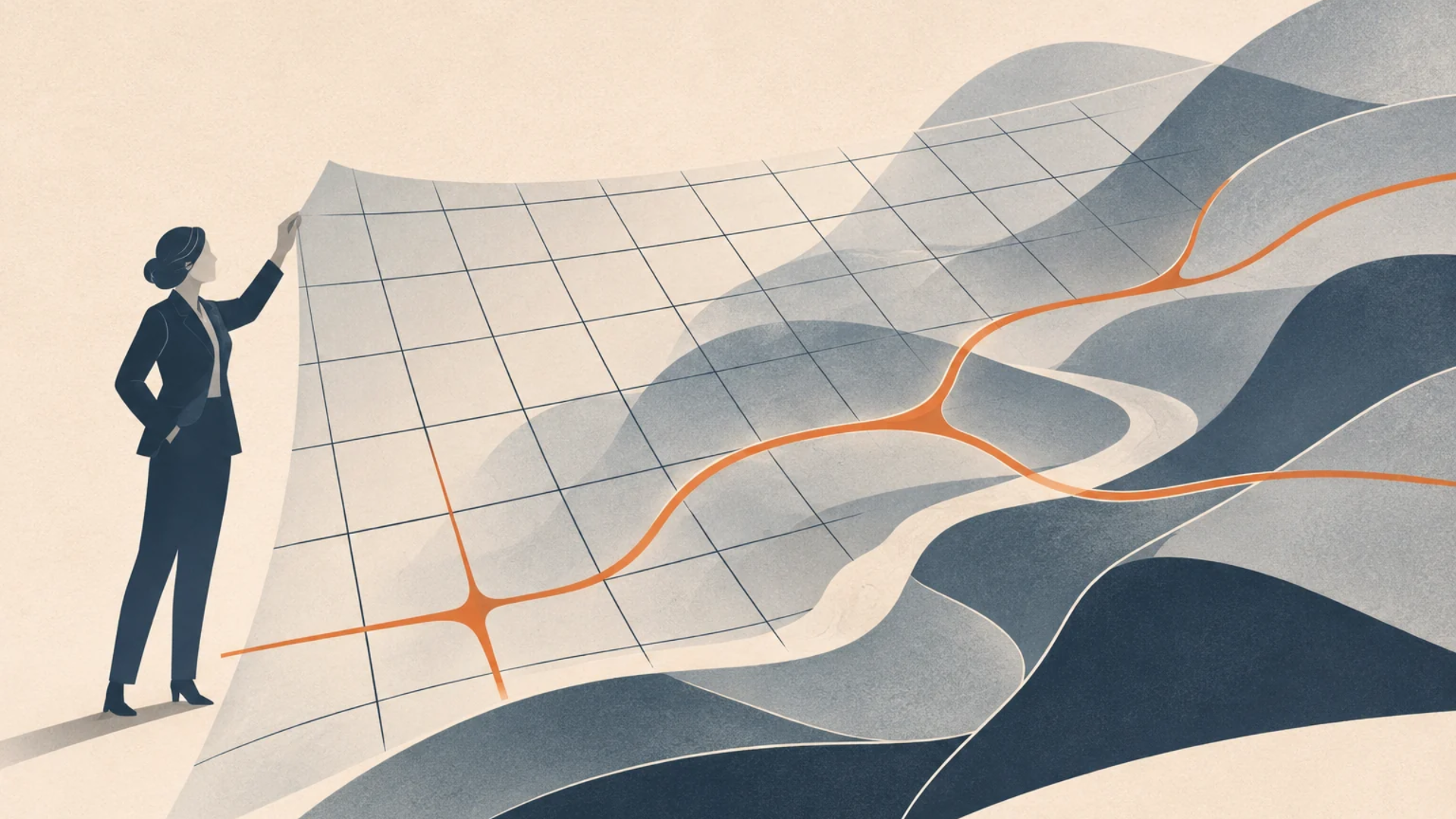
The lesson isn’t that Drucker was wrong; it’s that management is a social ecology, not a hard science. It is subject to the messy, non-linear forces of power, politics, and human emotion. To lead like Drucker, we shouldn’t just study his old conclusions. Instead, we should adopt his method of radical observation. Our job isn’t to find the “right” map (that is, a favored management model or framework) and follow it forever. Our job is to realize when the map no longer matches the territory and have the humility to draw a new one.
What are your “Hidden Assumptions”? Drucker’s misses weren’t due to a lack of intellect, but because even the best thinkers are shaped by the assumptions of their era. As you look at your own organization or career: What “obvious” trend are you betting on that might be more fragile than it looks? Are you managing for the world as it should be, or the world as it actually is?