
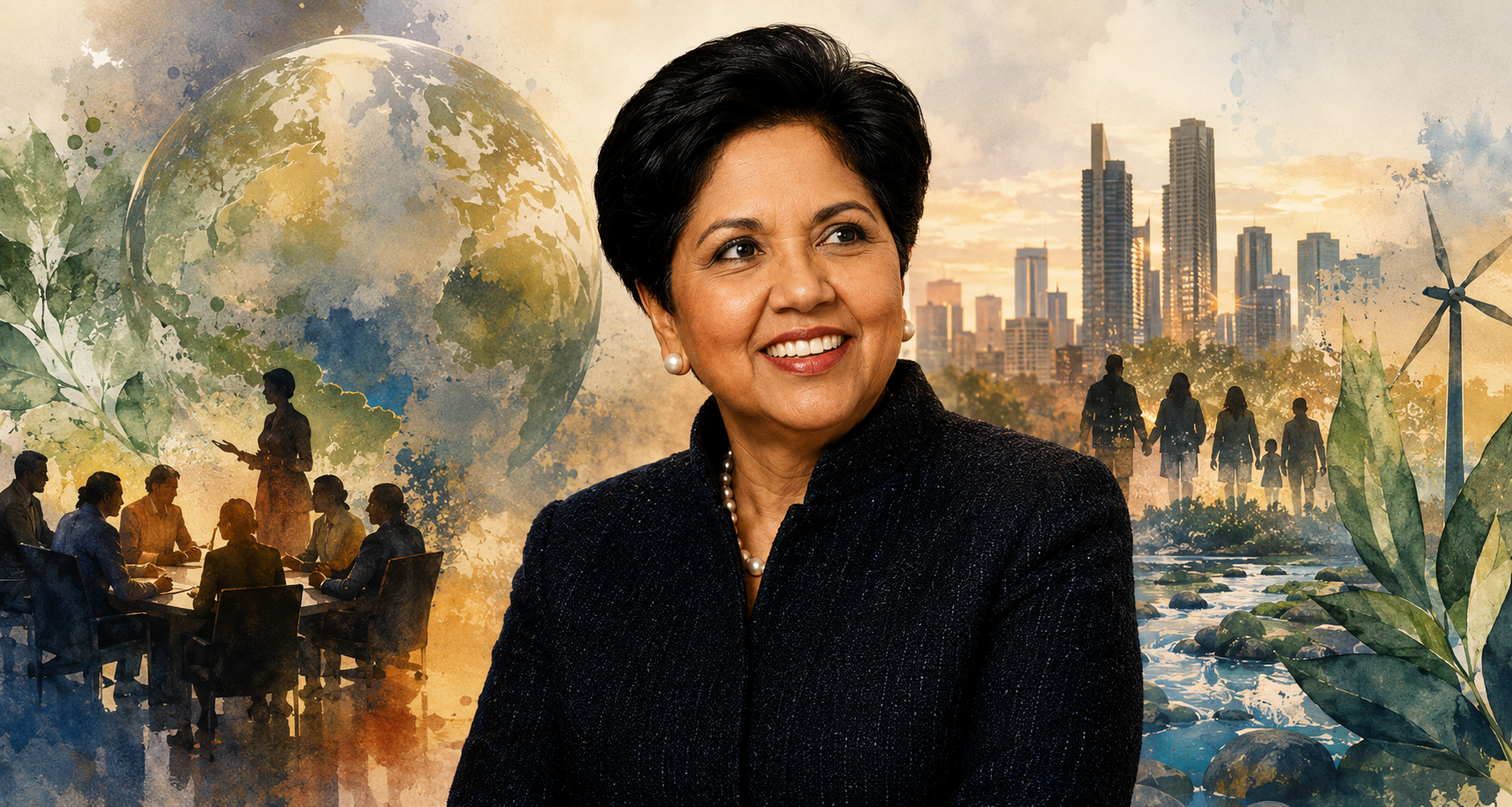
When Indra Nooyi became CEO of PepsiCo in 2006, she did not inherit a company in decline. Quite the opposite. PepsiCo was already one of the largest food and beverage corporations in the world, with brands such as Pepsi, Lay’s, Doritos, Gatorade, Quaker, and Tropicana. Its products were familiar, profitable, and part of ordinary life.
The business environment, though, was shifting under the company’s feet. Consumers were paying more attention to obesity, diabetes, sugar intake, and processed food. Governments and health organizations began questioning the role large corporations played in shaping diets. At the same time, water scarcity, plastic waste, and climate risk were becoming harder to dismiss as someone else’s problem.
Nooyi appears to have understood that PepsiCo’s size created obligations as well as opportunities. Her answer was Performance with Purpose, a strategy that connected financial success with healthier products, environmental responsibility, employee development, and community well being. Her tenure offers a useful example of Peter Drucker’s idea of Management as a Liberal Art. Drucker never viewed management as simply technical work. He argued that it draws on economics, ethics, psychology, history, politics, and the humanities. Managers lead institutions, and their decisions affect human lives whether they acknowledge it or not (Drucker, 1989).
Redefining Corporate Purpose
It is important to note that Nooyi never rejected profit. Indeed, she argued that purpose without performance would not survive inside a public corporation. Her larger point was more practical: profit could not be separated from the conditions that made long term business possible. A company could not ignore changing consumers, resource shortages, employee expectations, or community trust and assume its success would simply continue.
This resembles Drucker’s argument that profit is a condition of survival rather than the full purpose of an organization (Drucker, 1946). Businesses must earn enough to invest, employ people, and remain viable. Yet they also exist within society and depend on its stability. Nooyi treated PepsiCo as an institution whose choices influenced public health, agriculture, employment, and the environment.
Performance with Purpose rested on three pillars: human sustainability, environmental sustainability, and talent sustainability (PepsiCo, 2009). Human sustainability focused on nutrition. Environmental sustainability addressed water, energy, packaging, farming, and waste. Talent sustainability concerned employees, leadership development, and workplace opportunity. Nooyi wanted these considerations built into product design, investment, supply chain decisions, and long term strategy. Purpose was not supposed to sit in a separate office producing an annual report. It was meant to shape how PepsiCo made its money.
Rethinking the Product Portfolio
Perhaps the most difficult part of Nooyi’s strategy involved PepsiCo’s traditional products. The company earned enormous revenue from sugary drinks, salty snacks, and processed foods. Removing those products would have been commercially unrealistic. Consumers wanted them, retailers depended on them, and shareholders expected growth.
Nooyi instead divided the portfolio into products described as “Fun for You,” “Better for You,” and “Good for You.” Traditional snacks and soft drinks remained important. At the same time, PepsiCo invested in lower calorie beverages, reduced sodium products, oatmeal, sports nutrition, and smaller portions.
The categories were practical, though perhaps a little too tidy. A smaller bag of chips is still a bag of chips. Juice can carry significant sugar even when it appears healthier than soda. The language of consumer choice may also overlook how advertising, pricing, and product placement influence what people buy.
Nevertheless, Nooyi pushed PepsiCo to acknowledge a problem the industry had often treated defensively. The company could not speak credibly about human sustainability while ignoring health concerns connected to some of their most profitable brands. Under her leadership, PepsiCo reformulated products, reduced added sugar and sodium in parts of the portfolio, and expanded what it classified as everyday nutrition (PepsiCo, 2018a).
The transformation remained incomplete, but that may make the example more useful. Management as a Liberal Art does not ask leaders to pretend contradictions have disappeared. It asks them to recognize consequences, make deliberate choices, and accept responsibility for the institution’s direction.
Environmental Stewardship as Strategy
Food and beverage production depends heavily on water, energy, packaging, transportation, and agriculture. Nooyi treated these issues as operational business concerns rather than distant environmental causes.
PepsiCo worked to reduce water and energy use, redesign packaging, cut waste, and improve agricultural practices. The results were measurable. By 2012, the company reported it had improved water efficiency by 20 percent against a 2006 baseline, and it estimated its measures saved nearly 14 billion liters of water during 2012 while reducing costs by more than 15 million dollars (PepsiCo, 2013).
The example supported Nooyi’s claim that environmental responsibility and financial discipline were not always in conflict. A factory using less water or electricity reduced its environmental impact and lowered expenses. Lighter packaging used less plastic and cost less to ship. Better farming practices might protect soil while creating a more dependable supply of ingredients.
Still, the easy cases should not distract from the harder ones. Some improvements quickly pay for themselves, others require expensive investments whose benefits may not appear for years. Plastic remains widely used precisely because it is cheap, light, and durable. Corporate promises alone cannot solve the technical and economic problems involved in replacing it.
Here again Nooyi’s approach reflects Drucker’s emphasis on judgment. Management offers no formula for deciding exactly how much profit, environmental impact, or social benefit should count in a decision. Leaders must combine financial, scientific, ethical, and practical knowledge, then accept responsibility for the choice (Drucker, 1989).
Talent Sustainability and Human Dignity
Drucker believed organizations should give people both function and status. Employees need productive work, but they also need to feel that their contributions matter and that they are more than replaceable labor (Drucker, 1946). Nooyi’s focus on talent sustainability fits this idea.
At PepsiCo, talent sustainability included leadership development, employee education, workplace inclusion, and opportunities for advancement. PepsiCo University, for example, provided classroom and online learning for employees (PepsiCo, 2009). Nooyi also became known for a more personal gesture. She wrote letters to the parents of senior executives after noticing how proudly friends congratulated her own mother for raising a successful daughter.
A letter, of course, cannot replace fair pay or meaningful promotion opportunities. Even so, the gesture recognized that employees arrive at work with families, histories, and obligations that do not disappear when they walk through the office door.
Nooyi was also unusually candid about the strain between career and family. She discussed missing important events, depending on relatives and paid support, and struggling to meet expectations as an executive, wife, daughter, and mother (Nooyi, 2021). Her story complicates the familiar claim that success comes from ambition alone. Determination mattered greatly, but so did a network of people whose labor often remained invisible.
Design, Resistance, and Results
Nooyi brought design thinking into PepsiCo’s strategy by hiring Mauro Porcini as the company’s first Chief Design Officer in 2012. Her interest went well beyond appearance. She wanted leaders to consider the complete experience of buying, opening, using, and sharing a product (Ignatius, 2015). This reflected Drucker’s belief that business begins with the customer and that value is shaped by actual experience rather than what a spreadsheet assumes.
Her strategy still faced considerable resistance. Some investors questioned whether PepsiCo was spending too much time and money on healthier products and sustainability. Activist investor Nelson Peltz later urged the company to separate its snack and beverage businesses. Nooyi resisted, arguing that the combined company benefited from shared distribution, customer relationships, and bargaining power with large retailers.
The dispute highlights a genuine problem in responsible management. Long term language can become an excuse for weak performance. At the same time, investors seeking rapid restructuring may underestimate capabilities built over decades.
PepsiCo’s financial record offered support for Nooyi’s argument. Revenue rose from about 35 billion dollars in 2006 to 63.5 billion dollars in 2017, and the company reported a total shareholder return of 162 percent between the end of 2006 and the end of 2017 (PepsiCo, 2018b). These results do not prove that every part of Performance with Purpose succeeded. Growth came from many sources, including pricing, expansion, acquisitions, and the continuing popularity of traditional snacks.
Nevertheless, the record weakens the claim that attention to social and environmental issues automatically destroys shareholder value. The tension between purpose and profit remain, but Nooyi showed that the two could sometimes reinforce each other.
The Limits and Legacy of Purpose
Nooyi’s record should not be idealized. PepsiCo continued to earn large profits from products associated with poor nutrition. Its environmental programs reduced some impacts without solving broader problems connected to plastic, water use, or industrial agriculture. At times, the language of purpose probably moved faster than the transformation of the business.
Purpose can also become a flexible corporate label. A cost saving project may be described as environmental stewardship. A new product line may be presented as a public health contribution. Leaders must be careful to distinguish between a favorable story and measurable social results.
These criticisms do not erase Nooyi’s contribution. They make it more realistic. She moved health, environmental impact, employee development, design, and family responsibilities into strategic conversations that corporations too often reduce to finance and efficiency.
Overall, Indra Nooyi’s leadership at PepsiCo offers a persuasive, though imperfect, example of Drucker’s Management as a Liberal Art. She treated PepsiCo as more than a portfolio of profitable brands. It was a social institution whose decisions affected consumers, employees, farmers, communities, and natural resources.
Performance with Purpose attempted to connect those responsibilities to competitive strategy. Nooyi encouraged PepsiCo to rethink nutrition, conserve water and energy, improve packaging, developing employees, and consider the social conditions surrounding work. Her central lesson may be fairly simple. Purpose cannot survive without performance, but performance that ignores its human and social setting is unlikely to remain successful forever. In Drucker’s terms, management requires more than efficiency. It requires judgment, responsibility, and stewardship.
References
Drucker, P. F. (1946). The concept of the corporation. The John Day Company.
Drucker, P. F. (1989). The new realities: In government and politics, in economics and business, in society and world view. Harper and Row.
Drucker, P. F. (1990). Managing the nonprofit organization: Practices and principles. HarperBusiness.
Drucker, P. F. (1993). Post capitalist society. HarperBusiness.
Drucker, P. F. (1999). Management challenges for the 21st century. HarperBusiness.
Ignatius, A. (2015). How Indra Nooyi turned design thinking into strategy. Harvard Business Review, 93(9), 80 to 85.
Nooyi, I. (2021). My life in full: Work, family, and our future. Portfolio.
PepsiCo. (2009). PepsiCo releases 2008 corporate citizenship report.
PepsiCo. (2013). PepsiCo recognized for its sustainability efforts.
PepsiCo. (2018a). PepsiCo reports significant strides in pursuit of Performance with Purpose 2025 agenda.
PepsiCo. (2018b). Ramon Laguarta elected Chief Executive Officer of PepsiCo.