
Most people meet Peter Drucker as the man who invented management as a discipline – the author of The Practice of Management, the coiner of “knowledge worker,” the consultant kings and CEOs flew across oceans to see. What almost nobody knows is that in his seventies, between the management books, Drucker quietly published two novels. They are strange, beautiful, and a little unsettling. And if you read them back to back, you discover that the most famous management thinker of the twentieth century spent his fiction writing about a single question that has nothing obviously to do with management – and everything to do with it.
This is the story of that question, told through one sentence that Drucker wrote twice.
- Two novels that look unrelated
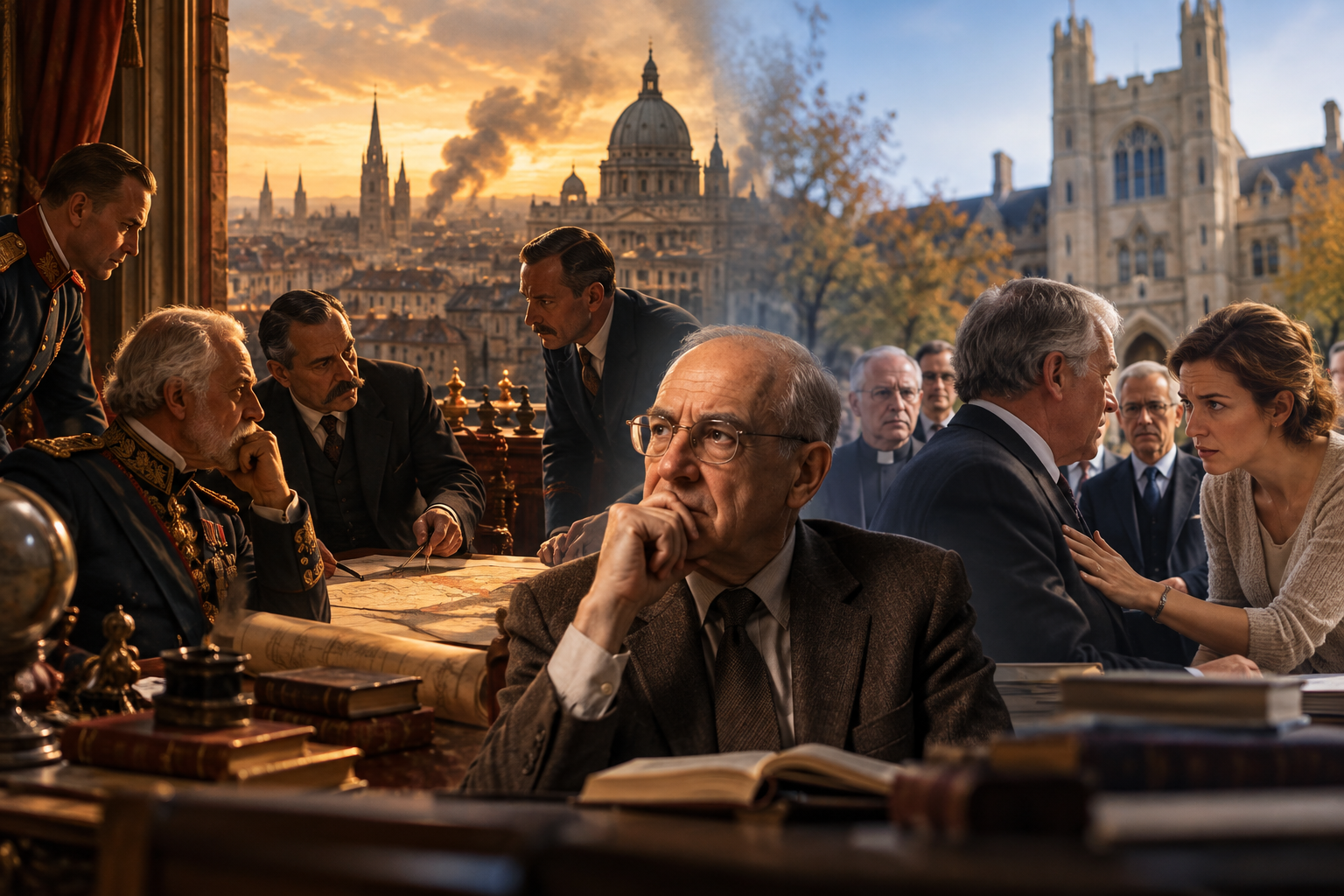
The first novel is The Last of All Possible Worlds (1982). It is set in London in June 1906 – high Edwardian summer, the last good days of old Europe. The characters take turns at center stage like instruments in a quartet: Sobieski, an aging diplomat of Polish royal blood serving the Austro-Hungarian Empire; Hinton, who climbed from a Göttingen doctorate in mathematics to the summit of London banking; Mosenthal, who rose from a junior clerk in Vienna to run an imperial bank. All are past sixty. All are taking stock of what comes next. The reader, of course, knows what the characters cannot: in eight years the shots at Sarajevo will bury this entire world.
The second novel is The Temptation to Do Good (1984). It jumps to the American Midwest, 1980: St. Jerome, a Catholic university that a formidable president, Father Zimmerman, has driven into the national first rank over twenty years. A mediocre instructor is about to be let go. His wife writes a poisonous letter accusing the president of “persecuting Catholics,” then spreads a rumor that he is sleeping with a young assistant. Nobody believes the rumor. And yet, by the end, the president is gone.
One book is an elegy for an empire; the other is a campus squabble. Seventy years apart, one written in lush prose, the other cold and clinical. They seem to have nothing to do with each other. But read them in sequence and, at some point, an attentive reader stops, flips back – because the same sentence has just beaten twice, like a heart.
2. The same sentence, in two persons
The first beat is in a memory from 1906. Early in The Last of All Possible Worlds, the diplomat Sobieski, restless one London morning, drifts back to a military-diplomatic meeting in Vienna the previous autumn. He had opposed a provocative, war-courting proposal, and a young general staff officer asked him, startled:
Are you a pacifist?
No, said the old man – I just don’t accept that line from Clausewitz your war colleges have worn smooth. War is not the continuation of diplomacy. War is the failure of diplomacy. And then -the novel adds the chilling detail that the general had stopped listening – he finished the thought :
“I am not opposed to war because it is unpredictable. I’m opposed to it because its aftermath has become only too predictable…But regardless of who wins, the loser in this world of ours is bound to be plunged into bloody anarchy – and perhaps the winner, too. Whoever wins, civilization is lost.”
The Last of All Possible Worlds (1982) Notice the small concession buried before the last line: and perhaps the winner, too. It seals off the last exit. If civilization loses, there is no real winner left.
The second beat is in a living room in 1980. Midway through The Temptation to Do Good, the faculty council at St. Jerome has just finished a small mutiny against the president. The law school dean, Dick Meyeroff, comes home full of righteous indignation, ready to organize the senior professors to defend the man. His wife, Sandra, sits down on his lap. She first hands him a piece of family wisdom — five generations of Kesslers in this country have learned never to step into the middle when the Gentiles fight, because they will instantly drop their quarrel and turn together on the meddling Jew — and then she says:
“No, it’s precisely because I’m so happy here that I don’t want you to do anything to endanger our life. And believe me, if you get mixed up in that fight, whoever wins, you’ll lose. Anyhow, why should you lead with your chin? What’s Erwin Ritter doing?”
The Temptation to Do Good (1984)
Whoever wins at the front, lose at the back. The same construcion, from the same pen, two years apart, dropped into two stories that share nothing. Drucker is not a writer who repeats a sentence by accident. The fingerprint tells us the difference in subject matter is a disguise. Both books are about the same thing.
Look at the two lines side by side. Sobieski’s is in the third person: whoever wins, civilization loses. It is the watchman’s ledger, keeping accounts for something that cannot keep its own. Saying it takes standing, and a near-futile kind of loyalty —because by the time he says it, no one is listening. Sandra’s is in the second person: whoever wins, you lose. It is the survivor’s warning, spoken out of love, backed by five generations of experience paid for in blood, and unanswerable on its own terms. That is exactly what makes it terrifying.
A verb has just been conjugated through two of its persons. And any reader will notice that the table is missing a row: the first person.
- The missing row
That row is blank because no one will sign their name to it.
Whoever wins, I must not lose – this sentence is never spoken in either novel. It can’t be said out loud; you can only read it backward, out of behavior. The physicist’s wife in the campus novel says it with a Nobel Prize sitting within reach (she stops her own husband too: “I will not have you offend the Swedes for the sake of a reactionary”). The old priests of St. Jerome say it with high talk about how “Caesar’s wife must be above suspicion.” But its purest utterance is not in either novel. It is in Drucker’s own memory.
That memory is in his autobiography, Adventures of a Bystander (1978). Spring 1933, the Nazis newly in power. Frankfurt University holds its first faculty meeting run by a Nazi commissar — the Nazis went after this university first, in Drucker’s words, precisely because it was “the most self-confidently liberal” of Germany’s major universities. The twenty-three-year-old Drucker sat in the audience. The commissar announced that Jewish faculty were barred from campus and dismissed without pay as of March 15, then, in barracks language, pointed at department chairman after chairman and threatened the concentration camp. Dead silence. Everyone waited for one man – the star of the science faculty, a Nobel-caliber biochemist whose liberal credentials were impeccable.
The great man rose, cleared his throat:
“Very interesting, Mr. Commissar, and in some respects very illuminating. But one point I didn’t get too clearly. Will there be more money for research in physiology?”
– Adventures of a Bystander (1978)
A budget question. That is the entire lyric of the sentence no one will sign. As the meeting broke up, Drucker adds, a few professors had the courage to walk out with their Jewish colleagues; most kept a safe distance from people who, hours earlier, had been close friends. Drucker went home that night, read the proof sheets of his own pamphlet – one he knew would be banned – and left Germany within forty-eight hours.
Now the three persons are complete: civilization, you, I. Distance shrinks from far to near; morality dims from light to dark. Two novels and a memoir turn out to be co-authoring one conjugation table — and the professor who spoke up about the research budget will reappear, four decades later, as the Nobel hopeful’s wife and as the defender of “Caesar’s wife.” When Drucker wrote novels in old age, he wasn’t changing careers for fun. He was building a specimen hall big enough to hold what he saw with his own eyes at twenty-three.
The hall has a name: the pathology of how civilizations collapse.
- The healthy tissue: a membrane
Pathology starts by dissecting healthy tissue. What does a civilization look like when it’s well? Drucker’s answer is a modest metaphor: a thin film. A membrane.
The image has a full backstory in The Last of All Possible Worlds. Sobieski earned the standing behind his war remark in the Paris Commune of 1871. Prussian armies ringed the city; mobs ran wild inside; he was the one diplomat who stayed, sheltering several hundred German civilians too poor to flee — tailors, bookbinders, small salesmen. The militia ordered to guard the legation turned and ran. The young Sobieski stood alone on the steps facing a crowd with murder in its eyes. They nearly lynched him; at the last moment the crowd wavered and broke. From that day he knew one thing, and spent the rest of his life finding that no one would believe it:
“No one believed how fragile civilization was, how thin the overlay of humanity over the brute, how little it took to unchain the savage.”
– The Last of All Possible Worlds(1982)
That is the dark side of the membrane: it tears, and faster than anyone imagines. The bright side the novel gives to another old man. The Spanish grandee, the Duke of Avila – from whose speech the book takes its title – argues that we are already living in “the last of all possible worlds,” the one in which kings, nobles, priests, burghers, peasants, and proletarians can coexist without cutting each other’s throats. Change it, and one group must dominate the rest:
“It’s [the last of all possible worlds] where all these groups and classes can live together without slitting each other’s throats and plunging into civil war. Change it, and one group must dominate – it doesn’t matter much whether it’s the rich who buy the military to shoot the poor, or the poor who take out their envy on the rest of us. There would be nothing left of what makes life worth living, none of the balance and diversity, the tolerance and choice, we call civilization.”
– The Last of All Possible Worlds(1982)
Thin as it is, the membrane does real work. It guards order, wraps up human nature, and gathers wildly different, mutually irritating people into a noisy but tolerable — even subtly harmonious —common life. Its function is fragile and immense: it binds the evil and frees the good.
What is the membrane woven from? Drucker had run the fiber analysis decades earlier. Before he was a management thinker, he was an exiled political scientist who wrote, in the middle of the Second World War, The Future of Industrial Man (1942):
“No society can function as a society unless it gives the individual member social status and function, and unless the decisive social power is legitimate power … If the individual is not given social status and function, there can be no society but only a mass of social atoms flying through space without aim or purpose.
– The Future of Industrial Man (1942)
Status and function; legitimate power. These are the warp and weft of the membrane. For an organization, the threads have more familiar names: mission and vision, and the leadership and order built on top of them. It is this film that turns an organization into a living body instead of a cloud of atoms.
But the membrane has a side effect Drucker watched for his whole life: the people inside it forget it is there. The longer they’re wrapped, the more naïve and optimistic they become, until they stop admitting the word evil — granting, at most, illness. Self-confidence is the illusion the membrane secretes, and the membrane tears first exactly where the illusion is thickest. The Nazis understood this perfectly. That is why their first cut went to the most self-confidently liberal university in Germany.
- The collapse under a microscope
The whole value of The Temptation to Do Good is that it puts the tearing of the membrane under a microscope — not the scandal of one organization, but a small-scale dress rehearsal for the fall of a civilization.
First, it separates the trigger from the cause. The trigger is a sick person: the instructor’s wife who wrote the poison letter, of whom even the novel’s psychiatrist will only say “she is just sick.” Every touchable injury, in the words of the priest who investigates, is at the level of “you used my scissors without my permission.” The cause is in the organism itself. The bishop’s diagnosis goes straight to the membrane: twenty years of breakneck growth had pushed everything in the university off true, so that no one really knew what the rules were anymore. Worse, an unanswerable question hung over the place – what makes a Catholic university great, and what makes a great university Catholic. Two visions, each with believers; the coalition that besieged the president was the odd alliance of the “great research university” party and the “great Catholic univrsity” party. The membrane did not tear during the crisis. It had long been eaten thin by the ambiguity of the mission. The poison letter was only the developing fluid.
Once a crack shows, the organization slides from outward service and ambition into an inward, zero-sum game. The iron law of zero-sum is simple: as long as the winner isn’t me, I’m a loser. So everyone gets pulled into the witch hunt — join in or get cut out — and the prisoner’s dilemma loops without end. For this process Drucker supplies not a plot but a climate. The final part of the novel opens with a Midwestern ice storm in early March, then says it plainly:
“The emotional climate at St. Jerome that early March faithfully mirrored the weather outside. It was very mean indeed.”
– The Temptation to Do Good (1984)
In a climate, no one decides; the atmosphere decides for everyone. Everyone knows the affair is invented, yet the knowing nods of “where there’s smoke there’s fire” keep multiplying. At the “Twelve Apostles” table where eight department-chair priests lunch every Friday, one session of group muttering against the president leaves the most coolly factual nun at the table – nicknmanes “Mrs. Facts” – in tears afterward, telling the bishop’s emissary: that was vile, vile, I felt I had become one of a lynch mob.
Then come three of the sharpest slices in the book.
First: inaction becomes evidence. What actually detonates the crisis is an editorial — and its most poisonous stroke aims squarely at the quiet exit of respectable people; of all the distinguished scholars and scientists Zimmerman had recruited to St. Jerome, not one had since thought it necessary to step up and defend the administration. Each individually blameless silence, summed, became printed “proof of guilt.” No one stood in the middle, and the empty middle itself became the prosecution’s testimony.
Second: the organization is the only reader of its own poison. The editorial ran in a dead little magazine called The Voice of Reason: circulation in the thousands, kept alive by a clause in its fouinder’s will, with exactly one subscriber in the whole city — the library of St. Jerome University. Within two days, all 970 faculty members had read it; the outside world didn’t blink. The editor of the big local paper said he’d be embarrassed to dignify the rag. The fire was entirely internal: the organization was the arsonist, the fuel, and the only reader, all at once.
Third: the route has a military name. The young priest sent by the bishop to investigate finally delivers his diagnosis through Hemingway’s A Farewell to Arms: St. Jerome reminds him of Caporetto – a beaten, leaderless army scattering in all directions, united only by hatred of its own high command. The place was losing its self-confidence, its decency, and its cohesion by the hour. And the besieged commander himself would not stand in his own middle either: he was not deposed; he abdicated at the first challenge.
The ending shows Drucker at his coldest. The one person who resolves to step into the middle — the bishop — has barely raised his guns when an act of “Providence” relieves him of the test: the chairman of a state commission dies, a vacancy opens, and Zimmerman becomes the perfect candidate to let everyone off the hook. He is graciously “promoted” away. The novel leaves the question hanging on purpose: the bishop wonders more than once afterward whether this miracle “had come down from heaven or up from below.” And the energy budget of the exile completes the final irony – the power that was nowhere to be found when the president needed defending was suddenly abundant when it came to disposing of him. The decisive move was the law dean lobbying his brothers-in-law, the local chamber of commerce’s heavy hitters. The very family Sandra invoked to talk her husband out of the fight became the key lever of the banishment. Her sentence comes true to the letter: whoever wins, the president loses — and her whole family is on the winning side. At the settlement, everyone is promoted: the bishop becomes archbishop, the young priest gets his ladder to Rome, the board chairman buys the naming rights to a building. In the bishop’s own words, the compensation owed to the victim of a judicial murder is a first-class funeral.
The collapse of an organization and the collapse of a civilization are now strictly the same shape. The only difference is the size of the specimen.
- The lesson is about human nature
But the pathology has one more layer, and it is where Drucker parts ways with every other “workplace novel”: the collapse is itself a lesson in human nature. It forces you to face a word that modern cleverness has quietly retired — evil.
Evil never disappeared; the membrane simply kept it bound. And the membrane’s illusion-making side lets the people inside downgrade evil into illness: ignorance, trauma, a psychological problem, a flaw in the system — in any case, something curable. This was the lifelong target of Drucker’s wariness, the standing posture of the rationalist liberal. The novel stamps that downgrade with a ready-made seal: the dead magazine that carries out the lynching is named The Voice of Reason — and Drucker gives it a résumé as a fellow-traveler organ that “faithfully followed every twist and turn in the Stalinist line” in the thirties, nicknamed in its day The Voice of Treason. That line — from the conceit of reason down into totalitarianism — is exactly the genealogy he had dissected at twenty-nine in his first book, The End of Economic Man (1939). When reason refuses to admit evil, reason becomes evil’s stationery; and the only one who reads the letter is the victim.
In an age that has downgraded evil, putting evil back in its place takes a kind of conversion. The novel hands that task to the one man best qualified to do the downgrading — the state mental- health commissioner, an atheist, the psychiatrist who used “hysteris” as a diagnosis for an entire book. At the end he telephones the now-departed president and surrenders his own categories:
“I mean all the others, the sane and normal ones, with their pettiness, their meanness, their delight in inflicting pain, their hurt vanities and inflated egos and their cowardice. Now I know that there really is evil – and then one needs God.”
The Temptation to Do Good (1984)
The sick are merely sick. The ones who need the category “evil” are the healthy. What fills the air as an organization collapses is what sociology calls atmosphere and psychiatry calls hysteria, but its real name is an ancient list – pride, envy, bearing false witness against one’s neighbor. The textbook for this lesson Drucker had already written in 1939: when the mechanical order promised by rationalism breaks down, what returns to rule are the demons –
“These new demons – poison gas and bombs from the air, permanent unemployment, and ‘too old at forty’ – are all the more terrible because they are man-made.”
– The End of Economic Man (1939)
- The verdict — and a spectrum
Follow the thread this far and you can pass sentence. Drucker wrote the verdict himself, at the end of that chapter in Adventures of a Bystander. The chapter tells of two real men. One, Hensch, a newspaper colleague who carried both a Communist and a Nazi party card in his pocket and finally showed up at Drucker’s door late one night in a storm-trooper’s uniform to recruit him “to work for us” – the Monster. The other, Schaeffer, one of Europe’s most respected journalists, sure he could “moderate the regime from within,” who took over a famous paper under Nazi rule and ended in ruin – the Lamb. The chapter is called “The Monster and the Lamb.” Drucker writes:
I have often wondered which of these two did, in the end, more harm – the Monster or the Lamb; and which is worse, Hensch’s sin of the lust for power or Schaeffer’s hubris and sin of pride? But maybe the greatest sin is neither of these two ancient ones; the greatest sin may be the new twentieth-century sin of indifference, the sin of the distinguished biochemist who neither kills nor lies but refuses to bear witness when, in the words of the old gospel hymn, “They crucify my Lord.”
– Adventures of a Bystander (1978)
Pride is a sin, lust for power is a sin, indifference is the great sin. But under the verdict we should lay a spectrum, because the specimens are not all the same cell. At one end is Sobieski – standing in the middle, the mob wavering and breaking before him. Then the bishop — meaning to stand, then bought off by a “miracle,” and knowing it (he admits in his closing monologue that he sacrificed a good man to avoid controversy and embarrassment, “and instead of being punished, I was promoted to archbishop. I know I wanted it — and worse, I know I’ll enjoy it”). Then Sandra — not indifferent at all; her sentence is in the second person, spoken out of love, backed by five generations of survival grammar, and Drucker is fair to her. Then the wife guarding the Nobel Prize. And only then the pure form of indifference – the professor who won’t even bother to fake the first person and just asks about the budget. Further into the dark, Schaeffer’s pride. Darkest of all, Hensch’s lust for power.
The point of the spectrum is one uncomfortable discovery: the climate is not built by evil men. It is built by respectable choices, each one locally optimal. That is the real horror of the prisoner’s dilemma, and the real double meaning of “the middle” running through the whole story – in a collapsing world no one stands in the middle, because everyoe is hiding in it. The middle has gone from the watchman’s post to the fence-sitter’s shelter. And history shows, again and again: when everyone makes sure not to lose, the loser is always civilization – and once civilization loses, Sobieski sealed the exit long ago, there is no real winner.
- The prescription
One question remains. The man who wrote these two pathology slides — what did he prescribe?
The prescription isn’t in the novels. It is in his other forty books. In 1973, Drucker published the thickest of them all, Management: Tasks, Responsibilities, Practices, and the title he gave the preface is the answer- “The Alternative to Tyranny”:
“But it is managers and management that make institutions perform. Performing, responsible management is the alternative to tyranny and our only protection against it.”
– Management: Tasks, Responsibilities, Practices (1973)
Put that line back next to the two novels and its full weight shows. Management, for Drucker, was never a science of efficiency. It is the craft of tending the membrane. Mission must be clear — St. Jerome died of the ambiguity between two visions. Status and function must be fully given — the fuel of the mutiny was wounded vanity and weightless position. Power must be legitimate – illegitimate power, in the end, has nothing left to use but the lynch mob. Why did Drucker write about management?
Because in the archives of the Paris Commune, in that 1933 meeting room in Frankfurt, at the editor’s desk he gave up himself at twenty-three, he had seen the world after membrane tears. The novels are the pathology slides; the management is the preventive medicine – two files kept by the same physician.
So two novels that look utterly unrelated in period, subject, and style are really about one thing, and that one thing is just one face of what all his other books are about. London, 1906: someone stood in the middle, speaking after the audience had drifted off – but he spoke, he stood, and the Commune’s mob did once break before him. Capital City, 1980: no one stood in the middle, so the membrane tore by its own physics, and respectable people each won their own little round and together lost the tolerable, subtly harmonious common world. Two lines answer each other across seventy-four years, like one syntax beating twice. The third line is forever unsigned.
And the reason the craft of tending the membrane is worth a man writing forty books is that the whole purpose of the craft comes down to a single thing — so that the third line never has to be spoken by “us.”
Sources
Peter F. Drucker, The End of Economic Man (1939)
Peter F. Drucker, The Future of Industrial Man (1942)
Peter F. Drucker, Management: Tasks, Responsibilities, Practices (1973)
Peter F. Drucker, Adventures ofa Bystander (1978)
Peter F. Drucker, The Last of All Possible Worlds (1982)
Peter F. Drucker, The Temptation to Do Good (1984)