

Peter Drucker has written a lot on management and leadership, but where did he stand in terms of his focus on the constructs of management and leadership? Was he more concerned with “managing” or “leading” in his writings? To take Drucker by his words, I conducted a computer-aided text analysis on all Drucker’s published books to objectively compare the number of times “manage” and “lead” have appeared in his writings. This way, I compared the relative frequency of words starting with “manage” (including manger, management, etc.) with “lead” (e.g., lead, leadership, leader etc.) in all Drucker books excluding novels.
Word Frequency Results
Using the machine-readable text versions of all Drucker’s books, I analyzed the relative word frequencies on Voyant Tools which is a powerful publicly available tool for computational linguistic (Sinclair & Rockwell, 2016). The figure below shows the frequency with which terms “manage” and “lead” have appeared in each of Peter Drucker’s written contributions. As evident in this figure, in 29 out of 32 of Drucker’s books, the relative frequency of “manage” is significantly higher than “lead”.
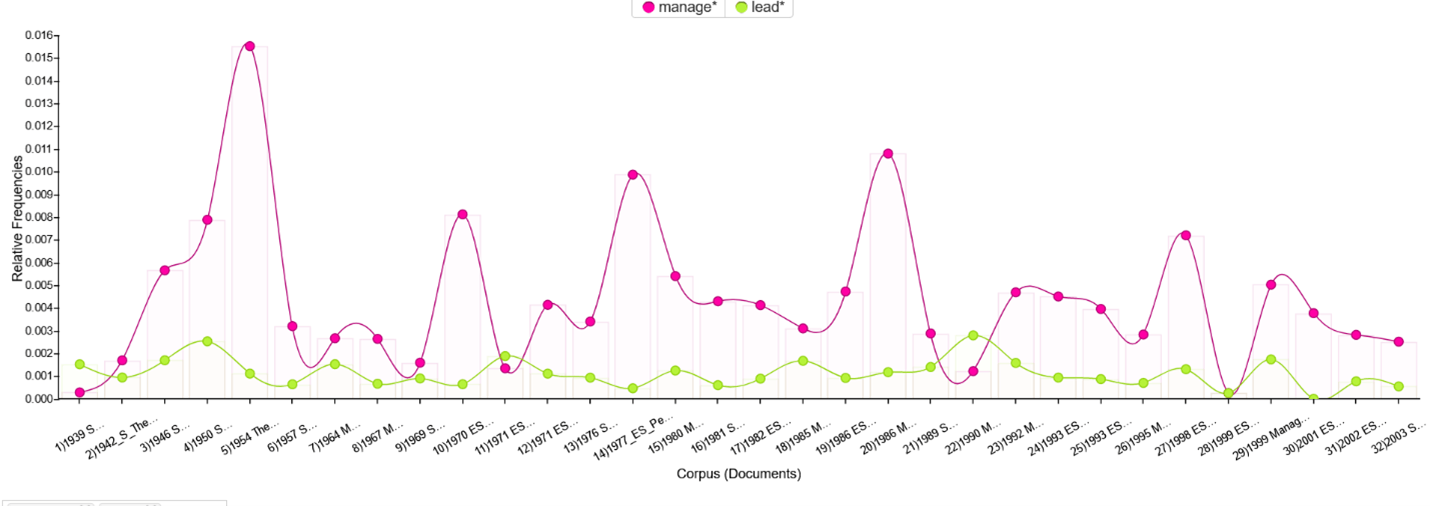
Similarly, I ran the same analysis at the aggregate level to compare the total number of times Drucker has used these words in his books. Looking at the aggregate frequencies (The total number of appearances in all 32 books), words including “lead” have appeared around 3010 times while words including “manage” appeared 13532 times . Thus, Drucker has used “manage” more than four times more frequently than “lead”.
Conclusion
This analysis shows that based on the frequency of words written by the author, Peter Drucker has put a far greater emphasis on the construct of management than the construct of leadership, throughout his writing career. This finding is not surprising considering Drucker’s dedication to general management topics. Nevertheless, this finding does not mean that Drucker has ignored leadership as an important organizational phenomenon. Drucker has written a lot about leadership and believed that effective leadership is less dependent on leader’s charisma and personality and more dependent on a leader’s ability for thinking through organizational mission. In this regard, Drucker had a very critical view of certain over-glorified views of leadership. Particularly, his negative views of charismatic leadership are evident in many of his writings. For instance, he believes that “The three most charismatic leaders in this century inflicted more suffering on human earth than almost any trio in history: Hitler, Stalin, and Mao (Drucker, 1990)”. Drucker considered leadership as “the essential” management skill.
For a deep understanding of Peter Drucker’s thoughts on leadership, I invite you to read “Drucker on leadership: New lessons from the father of modern management” by William A. Cohen (Cohen, 2009). In addition, Teo-Dixon and Monin (2007), have conducted an interesting study to track the evolution of the meaning of “leadership” through time in various Peter Drucker books and articles.
References
Cohen, W. A. (2009).
Drucker on leadership: New lessons from the father of modern management. John Wiley & Sons.
Drucker, P. (1990).
Managing the non-profit organization: Practices and principles. Harper Collins Publishers
Teo-Dixon, G., & Monin, N. (2007). Guru of gurus: Peter Drucker, logology, and the ultimate leader.
Journal of Management Inquiry, 16(1), 6-17.